

Defying Beijing, Thousands in Hong Kong Hold Tiananmen Vigil
Residents across the city gathered to commemorate the victims of China’s 1989 crackdown, despite a police ban. Hours earlier, the city made mocking China’s anthem a crime.


By Javier C. Hernández, Austin Ramzy and Tiffany May
Chanting slogans like “Liberate Hong Kong,” thousands of people in Hong Kong flouted a police ban on Thursday as they gathered to memorialize the Tiananmen Square massacre, a striking display of defiance against Beijing’s tightening grip on the territory.
“We have a responsibility to remember and to grieve,” said Clara Tam, 51, who took part in a vigil for the victims of the Chinese military’s brutal crackdown on pro-democracy protesters on June 4, 1989. “We have to let survivors know that we have not forgotten the children and loved ones they had lost.”
The public displays of anger and grief took on greater meaning this year amid a push by China to impose broad new security measures that take direct aim at the semiautonomous territory’s antigovernment demonstrations. In what critics see as the government’s latest attempt to curb dissent, Hong Kong on Thursday passed a law making it a crime to mock China’s national anthem.
China’s ruling Communist Party has sought to curtail Hong Kong’s pro-democracy movement after a year of demonstrations that sometimes turned violent. The unrest has erupted as Xi Jinping, China’s most powerful leader in decades, has overseen an expansive crackdown on dissent on the mainland, with officials deploying censorship and imprisonment to silence critics. Many residents in Hong Kong fear that their territory’s cherished civil liberties are in the party’s cross hairs.
In a break with tradition, the authorities in Hong Kong, citing fears about the coronavirus, imposed a ban on the Tiananmen vigil in Victoria Park, an annual event that often brings together a sea of candlelit faces against the backdrop of the city’s dense buildings. Officials urged residents to observe social distancing rules that barred public gatherings of more than eight people.
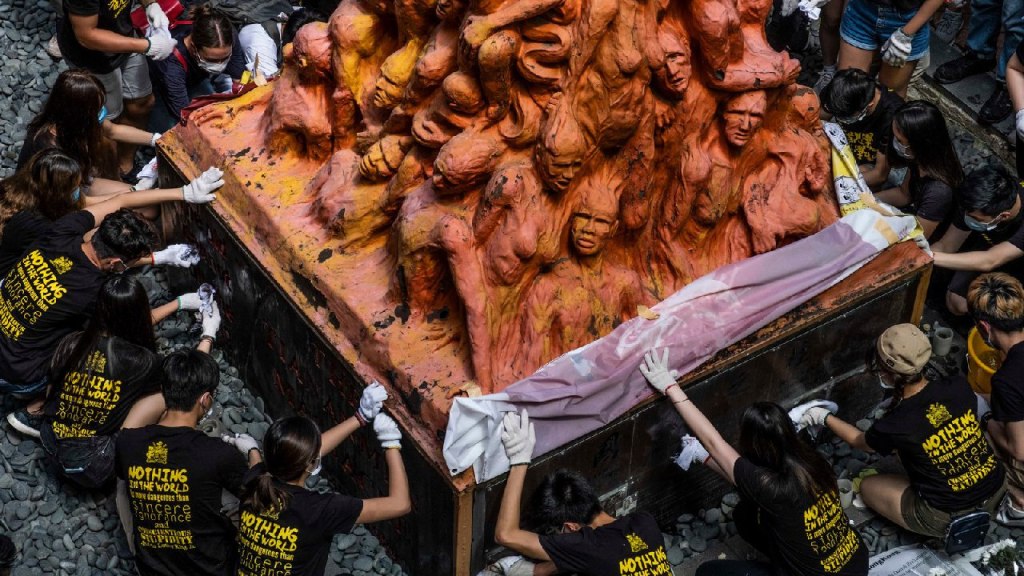
Still, activists filed into parks and subway stations on Thursday, facing off against police as they honored victims of the crackdown in several districts across the territory. Some stayed at home, lighting candles and praying for freedom. Others voiced protests in the legislature, denouncing China as a “murderous state.”
At Victoria Park, thousands of people hopped over fences and barriers to take part in a loosely organized memorial. Many people sat on the ground, holding lit candles. Some played songs that were used during the 1989 democracy movement in China. Public announcements about social distancing rules played over loudspeakers.
“What we are fighting for is the same: freedom and democracy. And they did so facing the risk of death,” said Mary Li, a 23-year-old university student, who sat with her friends in the park. “Coming here today, we may only be risking arrest. What they experienced makes me feel very somber.”
The authorities’ ban on gatherings was a blow to Hong Kong’s pro-democracy activists, who have for decades resisted the Chinese government’s attempts to erase the massacre from history. In mainland China, officials ban most discussions of the crackdown in which the government turned its troops and tanks on crowds of protesters, killing hundreds, if not thousands, of people. Now, the authorities routinely harass relatives of those killed and block any formal memorials.
- Where we left offIn the summer of 2019, Hong Kong protesters began fighting a rule that would allow extraditions to China. These protests eventually broadened to protect Hong Kong’s autonomy from China. The protests wound down when pro-democracy candidates notched a stunning victory in Hong Kong elections in November, in what was seen as a pointed rebuke of Beijing and its allies in Hong Kong.Late in 2019, the protests then quieted.
- How it’s different this timeThose peaceful mass rallies that occurred in June of 2019 were pointed against the territory leadership of Hong Kong. Later, they devolved into often-violent clashes between some protesters and police officers and lasted through November 2019. The current protests are aimed at mainland China.
- What’s happening nowThis latest round of demonstrations in Hong Kong has been fueled largely by China’s ruling Communist Party move this month to impose new national security legislation for Hong Kong.To China, the rules are necessary to protect the country’s national sovereignty. To critics, they further erode the relative autonomy granted to the territory after Britain handed it back to China in 1997.
- What this legislation would doThe rules would take direct aim at the anti-government protests and other dissent in Hong Kong. They are expected to prevent and punish secession, subversion as well as foreign infiltration — all of which Beijing has blamed for fueling unrest in the city.The legislation would also allow the mainland’s feared security agencies to set up their operations publicly in Hong Kong for the first time, instead of operating on a limited scale in secrecy.In trying to pass this legislation, Beijing is bypassing the Hong Kong government, and the legislation is being pushed by China’s rubber-stamp legislature, the National People’s Congress
Hong Kong has long hosted the only large-scale commemoration of the Tiananmen crackdown on Chinese soil. Each June 4, the hard-surfaced soccer fields of Victoria Park have served not only as a place to memorialize the dead, but as a history classroom for the young and a canvasing site for local pro-democracy groups.
The annual vigil also has acted as a gauge of whether Hong Kong can maintain the political freedoms that have become part of its identity, guaranteed under a policy known as “one country, two systems,” which was put in place when Britain returned the city to Chinese rule in 1997.


 Vermang News